IB Maths AA HL
Analysis and Approaches HL: calculus, proof, complex numbers, vectors and exam-level problem solving.
£140/week for 12 weeks or £1,500 upfront
IB Maths AA HL cohortTwelve-week online IB Maths AA HL and IB Physics HL cohorts of up to 8 students, led by Dr Bogdan Profir, Assistant Professor in Aerospace Engineering. Every topic builds step by step from clear explanations to exam-style questions, until students can solve them confidently on their own.
Solving
A vertical tangent
An absolute value puzzle
A quartic trigonometric equation
Charging a capacitor
Average speed
A loop leaving a magnetic field
The dog and the cat
Hovering helicopter
Shear force and bending moment
Rocket equation
Filling a cone
A chain on a scale
Sliding ladder
A pendulum on a rolling frame
Hemisphere on ice
Galileo’s fastest descent
Minimum relative speed
The grasshopper problem
The clowns problem
Group cohorts for IB Higher Level, and 1-to-1 support where depth matters most.
Analysis and Approaches HL: calculus, proof, complex numbers, vectors and exam-level problem solving.
£140/week for 12 weeks or £1,500 upfront
IB Maths AA HL cohortAll five themes of the current syllabus, from mechanics and fields to nuclear and quantum physics.
£140/week for 12 weeks or £1,500 upfront
IB Physics HL cohortEngineering mechanics and dynamics, fluid mechanics, aerodynamics, flight dynamics and thermodynamics for UK undergraduates.
1-to-1 from £65 per hour
Engineering tutoringCompetitive physics for students who want problems beyond the syllabus. 1-to-1 places are still available.
1-to-1 from £65 per hour
Olympiad physics preparationBefore you pay: please book a free 15-minute discovery call first, so we can make sure it is the right fit.
Three former students talk about where they started and where they ended up.
Alberto. Imperial College London engineering student. He had failed his maths module with under 40%; after tutoring he scored 74% on the resit, a first.
Ioana. Started tutoring before the IB to get ahead. She finished with 40 points and a 7 in Maths, and offers from Imperial College London, TU Delft, Eindhoven and Leiden.
Nikita. IB student who felt his maths grades slipping and wanted his understanding back. Here he explains why visual, conversational sessions worked for him. He now studies at the University of Bristol.
The structure follows university teaching: a concept session, a problem tutorial, then practice. Four hours of live teaching a week.
Each student can also book up to 2 hours of optional 1-to-1 check-ins across the 12 weeks.
Large classes move on once a topic is covered, whether or not every student has it. One-to-one tutoring fixes that, but students rarely hear how others think about a problem. A cohort of six to eight does both: everyone asks questions, and everyone sees several routes to an answer.
This is structured academic training rather than drop-in help. Students who attend, complete the problem sets and join the discussion make the most progress.
| Standard classes | M²PO cohort | |
|---|---|---|
| Group size | 20 to 30 | 6 to 8 |
| Pace | Moves on regardless | Checked every session |
| Questions | Rarely time for them | Expected |
| Problems | Routine textbook exercises | Exam and university level |
| Teacher | Generalist | Engineering academic |
From messages students and parents sent after their exams, shared with their first names.
She obtained maximum score in physics IB.Susan's daughter
Offers from Imperial College London and TU Delft.Ioana
I wanted once again to thank you for your help.Alberto · Oct 2024
Helped me to achieve what I wanted.Oliver · Jul 2023
Thank you for all your help!Alex · Aug 2024
I'm capped at 40% but im chuffed to be well above that.Nick · Sep 2024
Original reviews and messages, as they were sent. Tap any of them to enlarge.
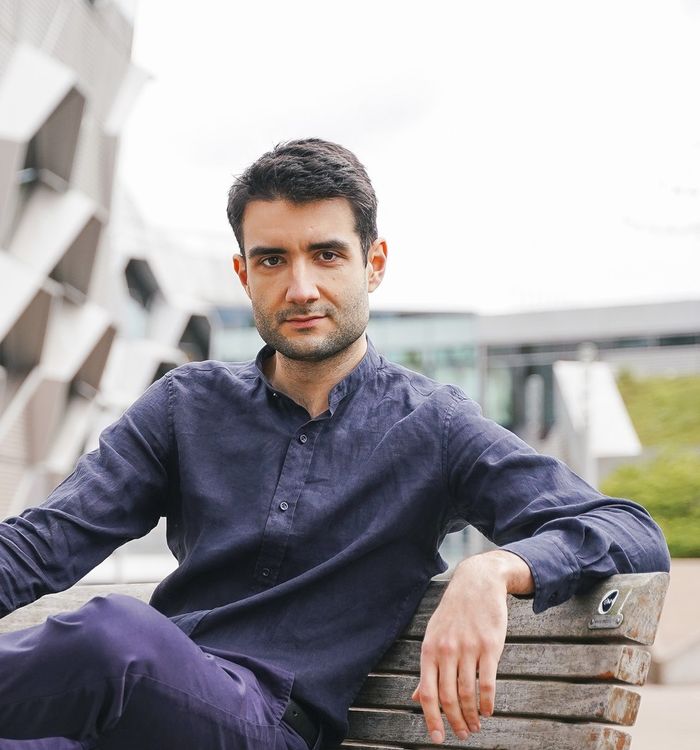
Bogdan is an Assistant Professor in Aerospace Engineering. He holds a Doctorate in Engineering (EngD) from the University of Southampton, carried out with Rolls-Royce. For it he built a Bayesian expert system: engineers' expert knowledge set the priors, experimental data updated them, and the model predicted behaviour in conditions where no test data existed. The aim was to replace some very expensive experiments, such as fan blade-off tests and fatigue tests of turbine discs to failure, with probabilistic prediction.
He has taught advanced mathematics and physics for more than 15 years, to IB students and university engineers in the UK and across Europe.
Book a free 15-minute discovery call. We talk through current grades, goals and the right next step.
Hi there! Ask me anything about the January cohorts, 1-to-1 tutoring or which programme fits. I'll reply on WhatsApp.